
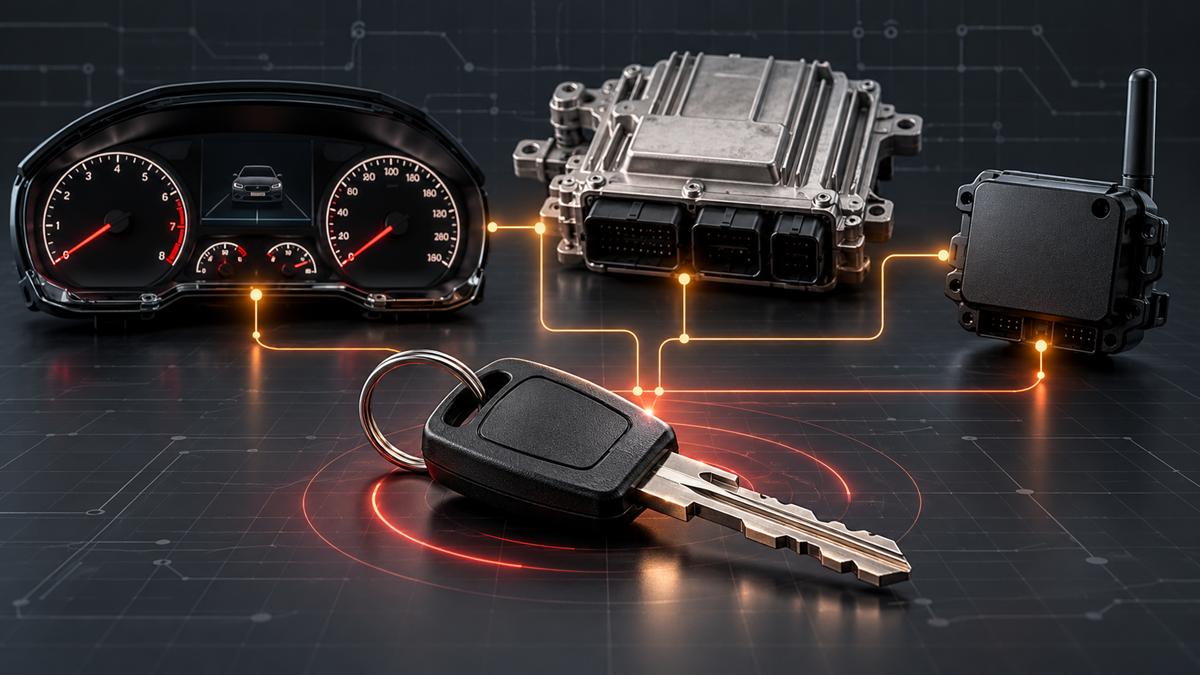
Ford used several versions of the Passive Anti-Theft System (PATS) between 1996 and 2014. The confusing part is that Ford did not use the letters A, B, and C to mean the same thing throughout that entire period. An older Ford chart identifies stand-alone, cluster-based, and PCM-based systems as Types A through G. A later Ford dealer aid starts a new A/B/C classification based on whether the PATS control function is located in the instrument cluster, body control module, or keyless-vehicle module.
This guide explains both classifications, shows common model-year applications, and provides a reliable way to determine which system a vehicle actually has.
What you will learn
- What PATS is checking before the engine is allowed to start
- What the key, transceiver, security controller, and PCM each do
- Why Ford's older A–G labels and later A–C labels must not be mixed
- How to narrow down the system using the vehicle, ignition type, and diagnostic module list
- Which symptoms support a PATS diagnosis—and which symptoms usually point elsewhere
The most important rule: never identify a Ford PATS system from the letter alone. Always pair the letter with the chart era, model year, vehicle model, ignition type, and module that contains the PATS control function.
What Ford PATS does
PATS is Ford's engine-start authorization system. A transponder in the ignition key or Intelligent Access device must be recognized by the vehicle. The module responsible for PATS then exchanges the required authorization information with the powertrain control module (PCM). If the expected information is missing or does not match, the vehicle may crank without starting, may not crank, or may display a theft or no-key warning depending on the platform.
The mechanical key blade, remote-control buttons, and PATS transponder are related parts of the key assembly, but they do different jobs. A blade can turn the ignition while its transponder is not recognized. Remote buttons can also fail even though the transponder still authorizes the engine to start.
The easiest way to understand PATS
Think of PATS as a short authorization conversation. The exact modules change from one Ford platform to another, but the basic idea remains the same:
- The driver requests a start. This happens by turning a keyed ignition or pressing the start button.
- The vehicle reads the security device. A transceiver around the ignition cylinder reads a conventional transponder key. An Intelligent Access vehicle communicates with a passive key through its keyless-vehicle electronics.
- The PATS controller checks authorization. Depending on the vehicle, this controller may be a stand-alone module, instrument cluster, PCM, BCM, RFA, or KVM.
- The PATS controller and PCM agree. On systems that split the security function between modules, the stored relationship must be valid.
- The PCM permits engine operation. If authorization fails, the vehicle follows the no-start or no-crank strategy designed for that platform.
The PATS type primarily tells a technician which module owns the authorization decision. It does not simply describe the shape of the key.
The parts of a Ford PATS system
| Component | Its job | What a problem may look like |
|---|---|---|
| Mechanical key blade | Turns the lock cylinder on a conventional keyed vehicle. | The key may not turn, but that does not by itself indicate an electronic PATS fault. |
| Transponder or passive key | Provides the electronic identity the vehicle expects. | A damaged or unrecognized device can produce a theft warning, no-key message, no-crank, or crank/no-start. |
| Transceiver or antenna | Communicates with the key near the ignition cylinder or designated backup location. | The vehicle may fail to detect otherwise valid keys. |
| PATS control-function module | Validates the key and manages the security relationship. Its location defines the system type. | Codes are often stored here rather than only in the PCM. |
| PCM | Allows or prevents engine operation after receiving the expected authorization. | A replacement PCM may be compatible yet still require the correct configuration or security relationship. |
| Theft indicator | Shows normal prove-out behavior and alerts the driver to a possible security concern. | Its meaning depends on when and how it flashes; normal key-off flashing is not automatically a fault. |
Why two different PATS type charts exist
Ford's March 2009 PATS job aid covers 1996–2010 vehicles and uses control-function Types A through G. Ford's 2013 PATS/RKE dealer aid uses a newer three-letter classification:
- Later Type A: Instrument Cluster Module (ICM)
- Later Type B: Body Control Module (BCM)
- Later Type C: Remote Function Actuator (RFA) or Keyless Vehicle Module (KVM)
The letters were reused. For example, an Escape listed as legacy Type C in the 2009 chart can appear as later Type A in the 2013 chart. That is not necessarily a contradiction: both descriptions place the PATS control function in the instrument-cluster family. The label changed because the newer report uses a different legend.
Legacy Ford PATS types: 1996–2010 chart
| Legacy type | Where the PATS control function is located | What the type means |
|---|---|---|
| A | Stand-alone PATS module | Early stand-alone architecture used on selected late-1990s vehicles. |
| B | Stand-alone PATS module | Later stand-alone architecture. It is not identical to Type A even though the controller location is similar. |
| C | Instrument cluster | The PATS function is in a VIC, HEC, ICM, or related instrument-cluster assembly. |
| D | Steering Column Ignition Lock module (SCIL) | A special application used on the 1997–1998 Lincoln Mark VIII. |
| E | Powertrain Control Module (PCM) | The PCM contains the PATS control function for the application. |
| F | Powertrain Control Module (PCM) | A PCM-based variation used on limited applications, including certain hybrids. |
| G | Instrument Cluster Module (ICM) | An ICM-based variation found on certain truck and van applications. |
Common 1996–2010 Ford and Lincoln applications
The table below is a quick reference to common North American applications in Ford's 2009 job aid. Build date, engine, gross vehicle weight rating, hybrid configuration, and special editions can change the answer. Missing model years should not be guessed.
| Vehicle | Model years | Legacy control-function type |
|---|---|---|
| Crown Victoria | 1998–2002 2003–2010 | B E |
| Edge | 2007–2010 | C |
| Escape | 2001–2007 2008–2010 | E C |
| Escape Hybrid | 2006–2007 2008–2010 | F C |
| Excursion | 2000–2005 | B |
| Expedition | 1997–1998 1999–2002 2003–2006 2007–2010 | A C E C |
| Explorer, four-door | 1998–2001 2002–2005 2006–2010 | B E C |
| Explorer Sport Trac | Early 2001 Late 2001–2005 2007–2010 | B E C |
| F-150 | 2004–2008 2009–2010 | E C |
| Flex | 2009–2010 | C |
| Focus | 2000–2007 2008–2010 | E C |
| Fusion | 2006–2010 | C |
| Mustang | 1996–1997 1998 1999–2004 2005–2009 2010 | A B C E C |
| Ranger | 1999–2000, 3.0L/4.0L 2001–2004 2006 2007–2010 | B E E Application-dependent C/G |
| Taurus | 1996–1997, Duratec/SHO 1998–1999, Duratec/SHO 2000–2006 2008–2010 | A B E C |
| Windstar | 1999–2000 2001–2003 | C E |
| Lincoln Navigator | 1998 1999–2002 2003–2006 2007–2010 | A C E C |
Special caution for E-Series, Ranger, and heavier F-Series applications: Ford's chart shows different C/G arrangements within some year ranges. Engine, weight class, and exact configuration must be verified before assigning a type.
Later Ford PATS types: A, B, and C
The later Ford dealer-aid legend is simpler because the letter identifies the module that owns the PATS control function.
| Later type | Control module | Typical vehicle arrangement |
|---|---|---|
| A | Instrument Cluster Module (ICM) | Common on keyed-ignition and Integrated Keyhead Transmitter applications carried into the early 2010s. |
| B | Body Control Module (BCM) | Common on newer electrical architectures in which the BCM manages the security function. |
| C | Remote Function Actuator (RFA) or Keyless Vehicle Module (KVM) | Used primarily with Intelligent Access and push-button-start systems. |
Common 2011–2013 keyed-ignition and IKT applications
| Vehicle | Model years | Later control-function type |
|---|---|---|
| C-MAX Hybrid | 2013 | B — BCM |
| Econoline/E-Series | 2011–2013 | A — ICM |
| Edge | 2011–2013 | B — BCM |
| Escape | 2011–2012 2013 | A — ICM B — BCM |
| Expedition | 2011–2013 | A — ICM |
| Explorer | 2011–2013 | B — BCM |
| F-150 | 2011–2013 | B — BCM |
| F-Series Super Duty | 2011–2013 | B — BCM |
| Fiesta | 2011–2013 | A — ICM |
| Flex | 2011–2012 2013 | A — ICM B — BCM |
| Focus | 2013 listed application | A — ICM |
| Fusion | 2011–2012 2013 | A — ICM B — BCM |
| Mustang | 2011–2013 | A — ICM |
| Taurus | 2011–2012 2013 | A — ICM B — BCM |
| Transit Connect | 2011–2013 | A — ICM |
| Lincoln Navigator | 2011–2013 | A — ICM |
Worked examples: following the controller through time
Mustang
The Mustang shows nearly the entire legacy progression: 1996–1997 models are listed as legacy Type A, 1998 as Type B, 1999–2004 as Type C, 2005–2009 as Type E, and 2010 as legacy Type C. In the later dealer aid, 2010–2013 Mustang is listed as later Type A because the new legend calls an instrument-cluster-controlled system Type A. The 2010 listings describe the same general controller location through two different naming systems.
Escape
The gasoline Escape is listed as legacy Type E for 2001–2007 and legacy Type C for 2008–2010. The newer dealer aid calls 2008–2012 Escape later Type A because the instrument cluster owns the function. The redesigned 2013 Escape moves to later Type B for the keyed/IKT arrangement, while an Intelligent Access version may use the later Type C RFA/KVM arrangement. This example shows why model year and ignition equipment must be considered together.
F-150
The common F-150 application moves from legacy Type E in 2004–2008 to legacy Type C in 2009–2010. The 2011–2013 truck is listed as later Type B, meaning the security control function moved to the BCM in Ford's newer electrical architecture. Special editions, weight classes, and applications not explicitly shown in the chart still require exact verification.
Push-button start changes the lookup
In Ford's later chart, Type C generally identifies Intelligent Access vehicles controlled by an RFA or KVM. Examples include certain 2011–2013 Edge and Explorer vehicles, 2012–2013 Focus vehicles, and 2010–2013 Taurus vehicles equipped with push-button start.
Push-button start is a strong clue, but it is not absolute proof of Type C. The 2013 Fusion and Lincoln MKZ are important exceptions: Ford's Intelligent Access table identifies those applications as Type B because the BCM owns the function. This is why looking only at the key or start button can produce the wrong answer.
What about model year 2014?
Model year 2014 belongs to the later networked PATS era, but the public Ford dealer aid referenced for this article ends with 2013 applications. Do not automatically copy a 2013 result to a 2014 vehicle. Confirm the 2014 vehicle by VIN, build date, ignition type, factory service information, and the diagnostic module that exposes the PATS service functions.
MoPower's current public Ford PATS service coverage stops at model year 2014. That coverage limit does not mean every 1996–2014 Ford uses the same system or that every vehicle in the range is automatically supported.
How to identify the PATS type correctly
1. Confirm the exact model year and build date
Use the VIN label and vehicle certification label rather than registration date or body style alone. Ford sometimes changed the control architecture during a model run. Early- and late-build vehicles can use different modules.
2. Record the complete vehicle configuration
Identify the model, engine, hybrid status, gross vehicle weight class where applicable, and whether the vehicle has a conventional keyed ignition, Integrated Keyhead Transmitter, or Intelligent Access with push-button start.
3. Identify the module that contains the PATS functions
Using appropriate factory service information or a capable diagnostic tool, determine which module presents the PATS functions:
- A dedicated PATS module points to a legacy A/B architecture.
- The PCM as the controlling module points to legacy E/F.
- A VIC, HEC, ICM, IPC, or instrument cluster points to legacy C/G or later A, depending on the chart era.
- The BCM or BdyCM points to later Type B.
- The RFA or KVM points to later Type C.
4. Read codes from the controlling module, not only the PCM
A PCM code such as P1260 indicates that engine operation was disabled because of a theft-system concern, but it does not identify the failed part. Ford directs technicians to retrieve codes from the applicable PATS control module. The module storing the related security codes is also a useful clue to the system architecture.
5. Verify the original and replacement module numbers
Connector shape and housing appearance are not enough. Record the original PCM engineering or service number, replacement-module number, and any available donor information. A compatible PCM still may require application-specific configuration or security authorization after installation.
6. Confirm the result before ordering programming
Provide the year, model, engine, build date, ignition type, PCM number, modules replaced, available keys, symptoms, and diagnostic codes. MoPower can then confirm whether a listed Ford PCM or PATS service applies to the exact vehicle.
How to interpret common symptoms
A symptom is a starting point, not a diagnosis. The table below separates useful PATS clues from conditions that often have another cause.
| Observation | What it can mean | What it does not prove |
|---|---|---|
| Theft indicator flashes rapidly with a start request | The key, transceiver, module communication, or stored security relationship deserves investigation. | It does not identify which component failed. |
| Crank/no-start after PCM replacement | The replacement PCM's compatibility, configuration, and PATS relationship should be checked. | It does not prove the replacement PCM is defective. |
| No-crank | PATS is possible only on applications that use starter interrupt. | It does not rule out the battery, starter circuit, range switch, ignition switch, wiring, or network faults. |
| P1260 stored in the PCM | The PCM recorded that engine operation was disabled because of a theft-system concern. | It does not identify the key, transceiver, cluster, BCM, RFA/KVM, or PCM as the failed part. |
| Remote lock/unlock buttons do not work | The remote, battery, receiver, or remote-keyless-entry system may need diagnosis. | It does not automatically mean the PATS transponder cannot start the engine. |
| Engine stalls while driving | Power, ground, fuel, ignition, PCM, sensor, or network faults should be investigated. | Ford's service information says PATS does not shut down an engine after it is already running. |
Why module replacement changes the repair plan
Replacing the PCM is not the same job as replacing the module that stores or validates keys. The required next step depends on the architecture:
- PCM replacement: confirm hardware compatibility, calibration, configuration, VIN requirements, and the PCM-to-PATS relationship.
- Cluster replacement: on a cluster-controlled system, the replacement affects the module that owns the PATS function.
- BCM replacement: on later Type B systems, the BCM is part of start authorization and cannot be treated as an unrelated convenience module.
- RFA/KVM replacement: on later Type C Intelligent Access systems, the keyless-vehicle module is part of security authorization.
- Lost or damaged key: key service may be needed even when every vehicle module is healthy.
This is why the correct question is not simply “Does this Ford have PATS?” The useful question is “Which module controls PATS on this exact vehicle, and which component was changed?”
What does not reliably identify a PATS type?
- The red theft light alone: indicator behavior varies by platform and can be normal at key-off.
- The key shape alone: similar-looking keys can use different control architectures.
- Remote buttons: remote keyless entry and engine-start authorization are not the same function.
- The model year alone: build date, engine, trim, hybrid status, and ignition option can matter.
- A P1260 code alone: it confirms a security-related disable request, not which component is defective.
- A replacement PCM seller's “plug-and-play” description: VIN, calibration, configuration, and PATS authorization are separate requirements.
Frequently asked questions
Are there three Ford PATS types or seven?
Both statements can appear in Ford literature because they refer to different chart eras. The 1996–2010 job aid uses legacy Types A through G. The later dealer aid uses A, B, and C for ICM-, BCM-, and RFA/KVM-controlled systems.
Does a later Type A mean the same thing as a 1996 Type A?
No. Legacy Type A is a stand-alone PATS module. Later Type A means the PATS control function is in the instrument cluster. The model year and source chart must always accompany the letter.
Can I identify the type by whether the vehicle has push-button start?
Push-button start suggests an Intelligent Access system and often points to later Type C, but there are BCM-controlled Type B exceptions. Confirm the responsible module.
Does replacing the PCM always require key programming?
No single rule applies to every Ford platform. The required work depends on which module stores the keys, which module was replaced, and whether the PCM and PATS controller still recognize each other. Diagnose the architecture before choosing a service.
Can PATS shut off an engine while driving?
Ford's job aids state that PATS does not shut down an engine after it has started and continued running. A vehicle that stalls while driving should be diagnosed for power, fuel, ignition, network, PCM, and other faults rather than being assumed to have a PATS problem.
Key takeaways
- PATS type describes the module that owns the security-control function.
- Ford's legacy A–G letters and later A–C letters are two different legends.
- The same controller location can receive a different letter in the newer chart.
- Key shape and theft-light behavior are useful clues, but neither is a complete identification method.
- The most reliable identification combines model year, build date, configuration, ignition type, module list, codes, and factory service information.
- A post-replacement no-start requires compatibility and configuration checks in addition to PATS investigation.
Before contacting MoPower
Have the following information ready:
- VIN, model year, model, engine, and build date
- Keyed ignition, IKT, or push-button start
- Original and replacement PCM numbers
- Which modules were replaced or programmed
- Number of available keys and whether either key previously started the vehicle
- Exact symptom: no-crank, crank/no-start, starts and stalls, or no-key message
- All PCM, cluster, BCM, and RFA/KVM diagnostic codes
Contact MoPower with those details before shipping a controller. Exact application confirmation is more reliable than choosing a service from the year range or PATS letter alone.